
MGS LH340 Slow Hardener (Qrt/net 0.81 Kg)
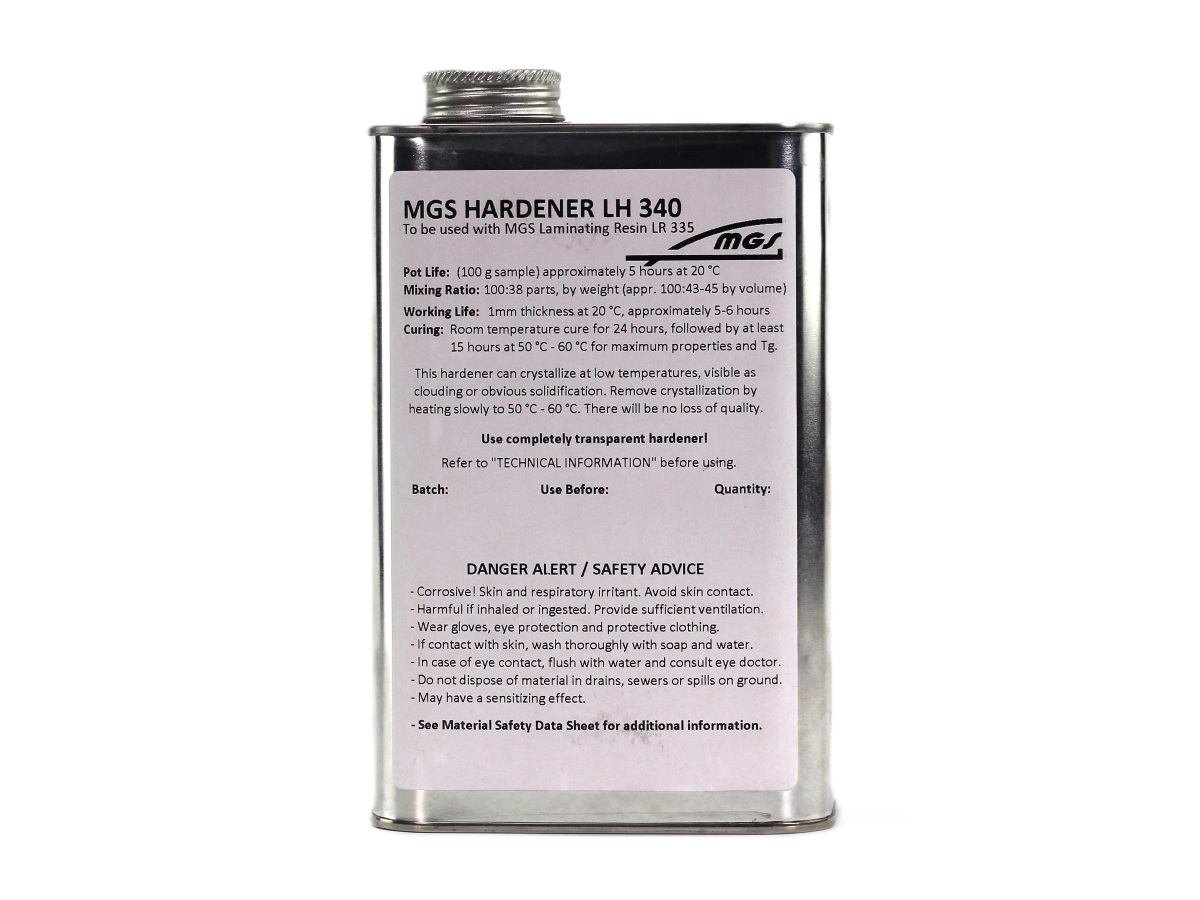
| System | |
|---|---|
| Industry | Marine |
| Container Size | Quart |
| Hazardous Good | Yes |
| Dimensions | 4.5 × 2.25 × 6.75 in |
Please Note – To accurately calculate your order total, freight must be evaluated based on size, volume, and hazardous material classification. The delivery information provided in the quote form allows the most cost-effective shipping method to be selected so the order can proceed directly to confirmation and shipment.
MGS Hardener 340 is a slow-curing agent specifically developed for use with MGS L335 Laminating Resin. It is designed for large-scale laminations and complex applications requiring extended processing times. This hardener delivers consistent mechanical properties and superior static and dynamic load-bearing capabilities. Approved by the German Federal Aviation Authority, Hardener 340 is ideal for demanding aerospace, marine, and automotive composite applications.
Application:
- Gliders
- Motor Gliders
- Sports Equipment
- Model Airplanes
- Molds and Tools
Mixing and Preparation
- Mixing Ratio: 100 parts resin to 38 ± 2 parts hardener by weight or 45 ± 2 parts by volume
Application Techniques
Wet Layup
- Description: Resin is applied directly to the reinforcement materials.
- Best For: Prototyping and small-scale projects.
Vacuum Bagging
- Description: Combines wet layup with vacuum pressure to improve laminate quality.
- Common Uses: Aerospace, marine, and automotive industries where high strength and precision are critical.
Application Tip: Mix the resin until it is completely clear with no cloudiness. Avoid over-mixing or under-mixing, as either can compromise the curing process.
Processing Temperature
- The recommended processing temperature range for Hardener 340 is 10°C to 50°C, with an optimal range of 20°C to 40°C.
Curing Process
- Initial Curing:Curing occurs at room temperature.
- Curing Agent Compatibility: MGS Hardener 335 is compatible exclusively with MGS L335 Laminating Resin
- Post-Curing:Post-curing at temperatures between 50°C and 60°C is recommended to enhance thermal stability and mechanical performance.
Data Sheets
- Technical Data Sheet
- Safety Data Sheet